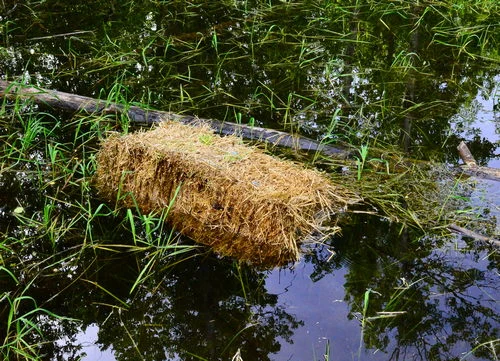

It’s a bit of a gardening “magic trick,” isn’t it? You toss a bundle of dried stalks into the water, and suddenly the pea-soup look starts to fade.
The interesting thing is that barley straw isn’t actually a herbicide or a scalicant—it doesn’t kill existing algae directly. Instead, it acts as a preventative measure through a fascinating chemical process.
The Science of the “Rot”
The magic happens as the straw begins to decompose. Here is the step-by-step breakdown:
- Decomposition: Once the straw is submerged and the water temperature rises above 10°C, fungi and bacteria begin to break down the lignin in the straw.
- Oxygenation: In the presence of sunlight and oxygen, this decomposition process releases humic acids into the water.
- The Chemical Reaction: These humic acids react with sunlight to create low levels of hydrogen peroxide ($H_2O_2$).
- Growth Inhibition: While the concentration of hydrogen peroxide is far too low to harm fish or plants, it is just enough to prevent new algae cells from growing and replicating.
Key Factors for Success
If you’re planning on using it, keep these “rules of the pond” in mind:
- Timing is Everything: Because it relies on decomposition, barley straw takes 4 to 6 weeks to start working. If you wait until your pond is already a thick mat of green, it won’t do much. It’s best to add it in early spring.
- Oxygen is Mandatory: The reaction requires oxygen. If you sink the straw to the very bottom where there’s no flow, it will just rot anaerobically (stink) and do nothing for the algae. Keep it near the surface or by a waterfall/pump.
- The “Goldilocks” Amount: Generally, you want about 10 to 25 grams of straw for every square meter of pond surface area.
Pros and Cons
| Feature | Benefit/Drawback |
| Eco-Friendly | Safe for koi, goldfish, frogs, and aquatic plants. |
| Cost | Extremely inexpensive compared to chemical UV clarifiers. |
| Speed | Slow. It is a preventative, not a “quick fix” for an existing bloom. |
| Aesthetics | Some people find the mesh bags of straw unsightly in a decorative pond. |
A Quick Tip: If you don’t like the look of straw bales floating in your pond, you can buy barley straw extract (liquid). It skips the rotting phase and gets the humic acids into the water immediately, though it usually needs to be reapplied more frequently.


