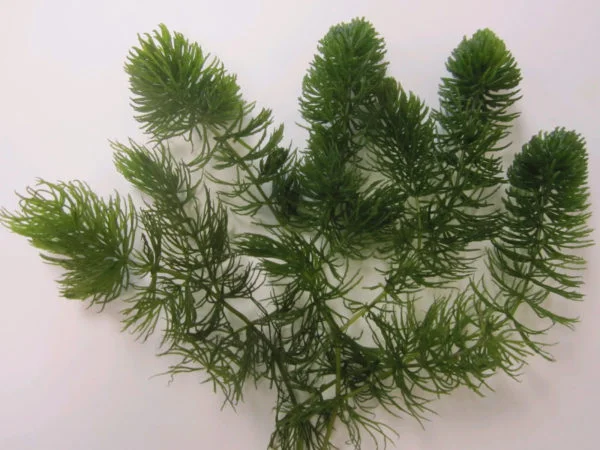

Oxygenating pond plants which are often also called “submerged” plants are a key component of maintaining a healthy aquatic ecosystem in your pond.
Unlike lilies and other plants which will sit happily on the surface of your pond, these plants live almost entirely underwater, and are one of the first things you should consider buying – personally I would argue before you even think about choosing your fish
Their primary job is to perform photosynthesis as all plants do, however unlike normal plants they perform this beneath the surface of the pond. As they do this they are consuming carbon dioxide and then releasing dissolved oxygen directly into the water. This is vital for fish health and for supporting the good bacteria that help to break down all the waste produced by fish and insects in your pond.
How They Benefit Your Pond
- Algae Control: One of the key things they do is to compete with algae for nutrients that are in the water such as nitrates and phosphates. More oxygenators will usually mean clearer water as they will work to starve any alage of key nutrients that it needs to survive.
- Filtration: Oxygenating pond plants will also act as a natural filter for your pond. They do this by trapping suspended particles that are in the water and also absorbing fish waste.
- Protection: They provide a “nursery” for fish fry and a hiding spot for frogs and newts from predators.
Popular Oxygenating Species
Depending on your pond size, below are some of the most popular varieties of oxygenating pond plants:
| Plant Name | Growth Habit | Best For |
| Hornwort (Ceratophyllum) | Rootless, feathery plumes | Low light and deep water; very hardy. |
| Water Starwort (Callitriche) | Tiny bright green leaves | Early season growth; great for wildlife. |
| Water Violet (Hottonia) | Fern-like foliage | Aesthetic beauty; produces pale lilac flowers. |
| Willow Moss (Fontinalis) | Dark, mossy clumps | Attaching to rocks or waterfalls in moving water. |
| Eelgrass (Vallisneria) | Long, ribbon-like leaves | Larger ponds; creates a “forest” effect. |
Planting and Maintenance
- Bunches vs. Pots: You can often buy them quite cheaply in weighted bunches to drop to the bottom, which is normally more than sufficient. Alternative you can also plant them in aquatic baskets with specialist aquatic compost and gravel.
- Depth: Most thrive at depths of 30cm to 90cm. Much deeper than 90cm and they may struggle to get the light required for them to function and survive
- Thinning Out: Because they consume nutrients so efficiently, they grow fast. In the summer, you may almost certainly end up having to pull out handfuls of the plant to prevent them from choking the pond and to ensure your fish still have somewhere they can swim..
- Winter Care: Most oxygenators are perennials. They will die back or sink to the bottom in winter and reappear when the water warms up in the spring.
At their core, oxygenating plants function like a biological engine for your pond. While all plants produce oxygen, these species are unique because they are fully submerged, meaning the gases they exchange happen directly within the water column rather than the atmosphere.
Here is the science behind how they keep your pond “breathing.”
Submerged Photosynthesis
The primary mechanism for their survival and growth is through the traditional plant process of photosynthesis. Because these plants live underwater, they have adapted to absorb sunlight through the water column.
- The Input: They absorb dissolved carbon dioxide (CO2) produced by fish respiration and decaying organic matter.
- The Process: Using a clever combination of chlorophyll and sunlight, they work to convert a combination of CO2 and water into energy.
- The Output: The byproduct of this process is dissolved oxygen (O2).
Unlike a water lily and other surface based plants that you can get for your pond, which releases its oxygen into the air through its top-side stomata, oxygenators release O2 directly from their leaves and stems into the water. On a sunny day, you can actually see “pearling”—tiny bubbles of pure oxygen rising from the leaves to the surface.
Nutrient Competition (The Algae Starvation)
Oxygenators are “heavy feeders.” They draw nutrients, specifically a combination of both nitrates and phosphates directly from the water through their leaves rather than just by using their roots as a traditional plant would.
By aggressively consuming these nutrients, they starve out single-celled algae (the stuff that turns your pond water into “pea soup”). This creates a cycle that helps the oxygenating plants and punishes the algae further:
- Plants eat nutrients.
- Algae dies off.
- Water becomes clearer.
- Sunlight reaches deeper.
- Your plants will then photosynthesise even more effectively.
A Note on Invasive Species: Be careful with plants such Elodea canadensis (Canadian Pondweed). While they are incredible oxygenators, they can also be highly invasive in some regions of the world if allowed into public waterways and as a consequence may be restricted.


